Launch Map Viewer
Launching map...


Design for Conservation

Design for Conservation


Public Lecture on Landscape Planning at Silpakorn University

Lecture Title: Landscape and planning in the predictive state: New negotiations for landscape architecture in the smart Earth era

Lecture Synopsis: Environmental planning is undergoing a transition from the environmental state—characterized by regulatory processes like environmental impact assessment—to a “predictive state” driven by machine learning, geospatial artificial intelligence, and real-time environmental sensing. This predictive turn complicates the role of civil society, experts, and democratic deliberation in environmental governance. This talk for landscape architects and planners is delivered in three parts: (1) a rapid introduction to key issues raised in critical geography on the socio-ecological implications of the real-time monitoring, prediction and regulation of landscapes; (2) a few examples in Southeast Asia of scientists and civil society deploying predictive models in ecosystem services and ecological connectivity for landscape assessment and infrastructure planning and design; and (3) some strategic approaches for landscape architecture during this transition.

Ashley delivers public lecture at Silpakorn University: Landscape and Planning in the Predictive State. By Silpakorn University, 2025.

Bio: Ashley Scott Kelly is assistant professor in landscape architecture at the University of Hong Kong. Ashley’s work focuses on scenario-building and filling knowledge gaps for sustainable development, applying design methods to land change and landscape ecology for the study, advocacy, design and delivery of projects in ecologically complex and contested landscapes. Recent works include tropical road design guidelines, wildlife corridor modeling, and coupling remote sensing with historical narratives for novel impact assessment. Ashley teaches landscape planning and geospatial technologies and engages civil society across Southeast Asia. He is co-author of Critical Landscape Planning during the Belt and Road Initiative (Springer, 2021).

Ashley delivers public lecture at Silpakorn University: Landscape and Planning in the Predictive State. By Silpakorn University, 2025.

Posted by: (Design for Conservation)

HKU Water Prize for two Thai-Myanmar Border Studio projects

Congratulations to Maggie and Marcus, two of our HKU Landscape BA(LS) graduates who won the Prize for Outstanding Water Sustainability Undergraduate Capstone Project awarded by HKU’s Water Centre for their final-year studio projects.

Project: “Embedding landscape in riverine reserve design: Ecological metrics and manageability to strengthen unplanned community-based conservation networks in northern Thailand”

Marcus Leung Lok Yin proposes a landscape planning framework for increasing the sustainability and resiliency of one of Southeast Asia’s largest networks of community-based fish conservation zones. The roughly 50 existing zones were established and managed by the majority ethnic Karen villagers in Thailand’s Mae Hong Son Province over the past three decades. Existing freshwater ecology research on this network suggests it had a net positive effect on fish sustainability but that overfishing pressures continue to have adverse ecological impacts. Marcus’s framework challenges and extends a previous ecological assessment of this network by considering several additional landscape metrics for gauging the suitability and capacity of individual communities to fill gaps in the conservation network with additional zones. Karen people are deeply attached to the water, and these fish conservation zones provide a wide range of community benefits, including food security (fish is their primary protein source) and cultural sustainability. Marcus uses his landscape architecture and planning skillsets to accomplish the difficult task of simultaneously considering traditional ecological knowledge, science on freshwater ecology, and the political-economic legacies of Southeast Asia’s highland communities.

Project: “Field operations on hydrosocial territories: Landscape impacts of reservoir construction on the lower Yuam River, Thailand”

Maggie Yao Renyue proposes a series of strategies for the majority ethnic Karen communities living along the diversion tunnel’s planned 20-kilometer-long reservoir in Thailand’s Mae Hong Son Province. The diversion tunnel requires over one thousand check dams (weirs) to be constructed within the immediate catchments surrounding the reservoir to regulate water flow and sediment. Maggie first interrogates the planning and construction process of this highly dispersed system of weirs and considers their potential impacts on both the freshwater ecology and communities’ agricultural livelihoods. She then proposes (1) repurposing these weirs to maximize benefits to both agriculture and local ecology, and (2) taking advantage of nascent ecotourism opportunities. Maggie’s project has numerous compelling strengths, including her investigation of past legacies of development in the project area, consideration of cross-sector impacts beyond the status quo assessment, focus on community livelihood and cultural sustainability, scenario-building to deal with the uncertainty of large-scale development, and incorporating tactical landscape architecture and civil engineering interventions into larger-scale planning.

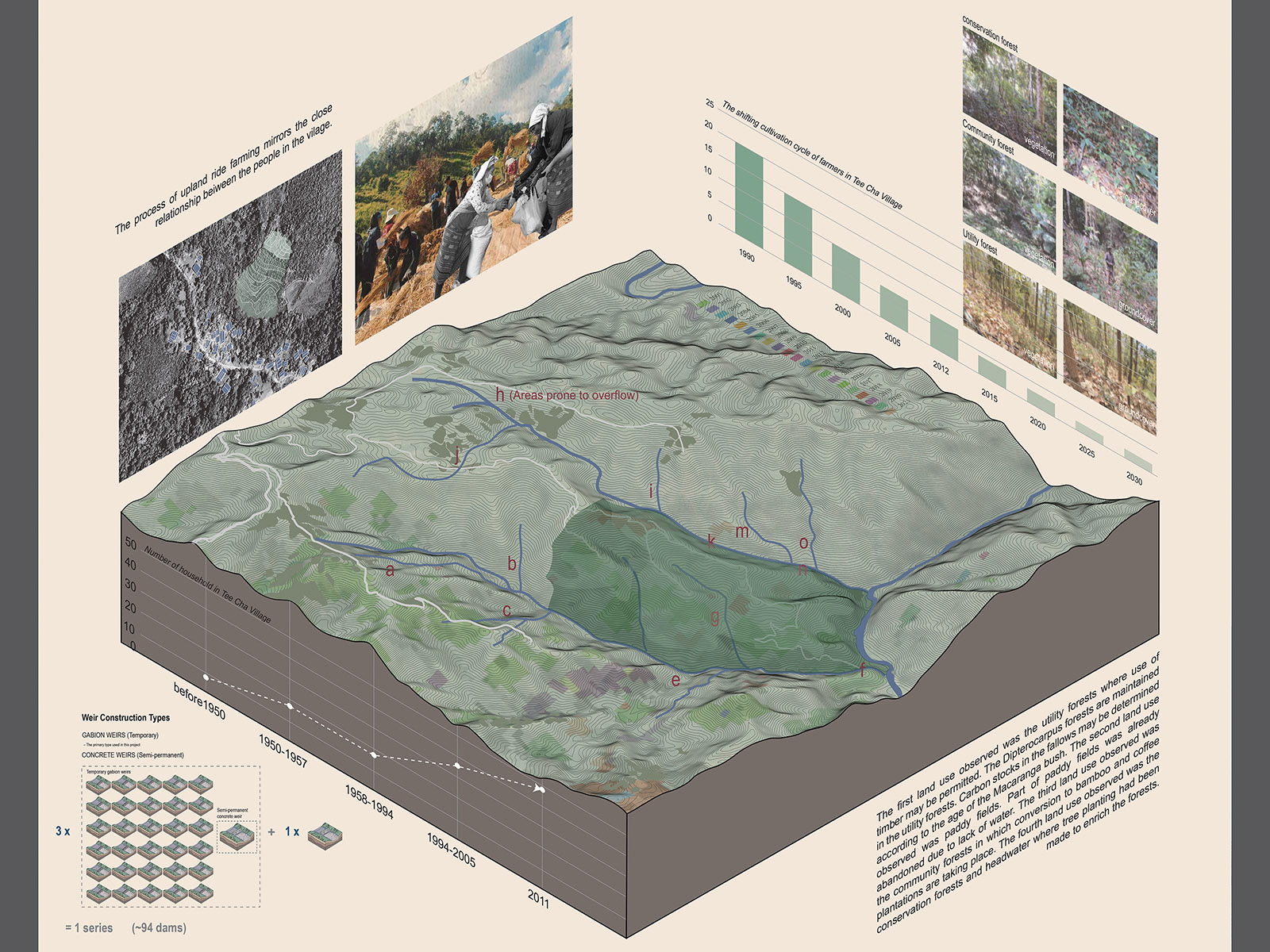
Field operations on hydrosocial territories: Landscape impacts of reservoir construction on the lower Yuam River, Thailand. By Maggie Yao Renyue, 2025.
Embedding landscape in riverine reserve design: Ecological metrics and manageability to strengthen unplanned community-based conservation networks in northern Thailand. By Marcus Leung Lok Yin, 2025.

Posted by: (Design for Conservation)

Thai-Myanmar Border Studio, Final Review

Final-year Bachelor of Arts in Landscape Studies students presented their final proposals for landscapes impacted by a planned 60-kilometer water diversion tunnel in northern Thailand. During this capstone studio on the Thai-Myanmar border, led by Ashley Scott Kelly and Yuan Zhuang, our landscape undergrads develop and present a 100-page research report to civil society organizations, visit a diverse range of development projects and programs across northern Thailand, individually design strategic planning proposals, and have their work juried by a panel of experts from planning, sociology, ecology, geography, and design.

This year’s jury included: Prof. Kelly Shannon (International Center for Urbanism, KU Leuven); Naruemon Thabchumpon (Fac. of Political Science, Chulalongkorn Univ.); Warong Wonglangka (Fac. of Architecture, Chiang Mai Univ.); Vanessa Lamb (Dept. of Social Sciences, York Univ.); Winnie Law (HKU Centre for Civil Society and Governance); Barry Day (Asia Design Director, B+H Architects); Zali Fung (Inst. of Geography and Sustainability, Univ. of Lausanne); Sunita Kwangta (Karen Environmental and Social Action Network, KESAN); Phnom Thano (Co-founder of Indigenous Media Network, Thailand); Xiaoxuan Lu (NUS Architecture); Cecilia Chu (CUHK School of Architecture); Inge Goudsmit (CUHK School of Architecture); Peter Cobb (HKU School of Humanities); Elizabeth Leven (Asia Ecological Consultants, aec Ltd.); Anhua Liang (SWA Group, Shanghai); Olgierd Nitka (Studio94); and several planners and designers from HKU Planning, Architecture, and Landscape Architecture.

The students, Ashley and Yuan express their gratitude to the jury and to HKU for its continued support for fostering critical and essential discussions about landscape development across the regions. Congratulations to all students!

Yannie presenting at HKU Landscape’s Public Review. By Tang Chi Tat, 2025.
Reforestation as self-determination: Broad-based integration of the framework species method in post-secondary education, Karen State, Myanmar. By Yannie Cheng Sum Yu, 2025.
From cut to connectivity: Challenging the planned mitigation of transmission-line corridors in the Karen highlands of northern Thailand. By Jennifer Chung Pui Shan, 2025.
Jennifer presenting at the Final Review to a panel of experts from planning, sociology, ecology, and geography, in addition to designers and planners. By Vicki Liu Jiani, 2025.
From cut to connectivity: Challenging the planned mitigation of transmission-line corridors in the Karen highlands of northern Thailand. By Jennifer Chung Pui Shan, 2025.
Road ecology in Zomia's last frontier: Mediating the new economic geographies of transmission lines, interbasin water transfer and access roads. By Celine Xiong Yuchen, 2025.
Celine presenting at the Final Review to a panel of experts from planning, sociology, ecology, and geography, in addition to designers and planners. By Tony Tsui Ho Yin, 2025.
Victor presenting at HKU Landscape’s Public Review. By Tang Chi Tat, 2025.
Refugees and resilience: Scaling up community-driven natural resource management amid food security crises and mega-infrastructure development on the Thai-Myanmar border. By Victor Jorge Lew, 2025.

Posted by: (Design for Conservation)

HKU Landscape Undergrads Travel to Northern Thailand

HKU Landscape undergrads traveled to northern Thailand in early March for their final-semester studio on regional landscape planning. During the 10-day trip, students traveled more than 500-kilometers overland to document sites planned for hydropower, interbasin water transfer, spoil disposal areas, flow regulation check dams for reservoir construction, river dredging, access roads, and high-voltage transmission lines. Students also visited case study sites of urban reforestation in Bangkok, rural reforestation in one of Southeast Asia's most extensive chronosequences of tropical forest plots near Chiang Mai, and a vast network of community-based fish conservation zones spanning parts of Chiang Mai, Mae Hong Son, and Tak provinces. Students learned of the complexity of large-scale development and conservation project planning and of the challenges—technologically, politically, and physically—in working off-the-grid in remote and mountainous sites.

The students and their instructors professor Ashley Scott Kelly and Yuan Zhuang thank the People's Network of the Yuam, Ngao, Moei and Salween River Basin; the Karen Environmental and Social Action Network (KESAN); The Border Consortium (TBC); International Rivers; the Regional Community Forestry Training Center for Asia and the Pacific (RECOFTC); the Forest Restoration Research Unit (FORRU) of Chiang Mai University; landscape architecture practices Northforest Studio and TK Studio and academics from Chulalongkorn and Chiang Mai Universities; and generous support from numerous friends in the region. Wish the students the best of luck designing their studio projects in the second half of the term.

HKU Landscape BA(LS) students at the boundary of one of over 50 community-based fish conservation zones in the Ngao River basin. By Ashley Scott Kelly, 2025.
Overview of the watershed where a planned reservoir, hydropower dam, interbasin transfer pumping station, check dams, and access roads could impact ecological and cultural landscapes on a major tributary of the Salween River. By Ashley Scott Kelly, 2025.
Students at one of six planned spoil disposal areas for the construction of a 60-kilometer water transfer tunnel and supporting infrastructure. By Ashley Scott Kelly, 2025.
Students learning about fish ecology and community management of the Ngao River, Mae Hong Son, Thailand. By Ashley Scott Kelly, 2025.
Students within the planned reservoir area and tunnel intake location where a Buddhist ceremony was recently held to protect the river. By Ashley Scott Kelly, 2025.
HKU Landscape BA(LS) students meet with the Southeast Asia campaigns director for International Rivers. By Ashley Scott Kelly, 2025.
Meeting with The Border Consortium (TBC), the NGO coordinating refugee support in Thailand, at their offices in Bangkok. By Ashley Scott Kelly, 2025.
Meeting with the Regional Community Forestry Training Center for Asia and the Pacific (RECOFTC) at their headquarters in Bangkok. By Ashley Scott Kelly, 2025.
Students assist the drone survey of a forest plot with the Forest Restoration Research Unit (FORRU), Chiang Mai University. By Ashley Scott Kelly, 2025.
Confluence of the Ngao and Khong Rivers at Chiang Mai, Mae Hong Son, and Tak provinces, Thailand. By Ashley Scott Kelly, 2025.
Confluence of the Yuam and Ngao Rivers where a 20-kilometer-long reservoir and intake station are planned for an interbasin transfer tunnel. By Ashley Scott Kelly, 2025.

Posted by: (Design for Conservation)

Thai-Myanmar Border Studio 2024 Final Review

HKU Landscape undergrads just concluded their final year with our Thai-Myanmar Border Studio. For its second year, this landscape planning studio course, led by professor Ashley Scott Kelly, examined a series of contentious and protracted development projects along the border between Thailand and Myanmar. These projects included planned dams on the Salween and Yuam rivers, a coal mine in Chiang Mai province, and a large-scale water diversion tunnel proposed from the Salween to Chao Phraya basins.

Students gain understanding in the studio not only of how planners or architects or landscape architects might be involved in large-scale planning projects but also how cultural anthropologists or political scientists might approach, evaluate, and address development throughout Southeast Asia. The curriculum combines both desktop research and field visits and addresses topics including environmental histories of Thailand and Myanmar, participatory and customary mapping, transnational advocacy for environmental and human rights, land governance, traditional ecological knowledge, conservation science, villager research, and environmental assessment.

In mid-March, students embarked on a 10-day overland journey covering approximately 400 kilometers from Chiang Mai to Mae Sot. During this trip, students engaged with several environmental and human rights advocacy groups, including The Border Consortium (TBC), Karen Environmental and Social Action Network (KESAN), indigenous community groups, the Assistance Association for Political Prisoners (AAPP), and ecologists from the Forest Restoration Research Unit (FORRU) and sociologists from the Center for Ethnic Studies and Development (CESD) at Chiang Mai University. Then, for eight weeks after returning to Hong Kong, students developed landscape planning proposals that coordinated environmental knowledge through community mapping, villager research, and citizen science; addressed conflicts between biocultural diversity and scientific reforestation programs; and navigated diverse cultural and environmental value systems in dual-governed regions.

Students defended their proposals at the final review with a diverse jury, including Richard Engelhardt (Former UNESCO Regional Advisor for Culture in Asia and the Pacific); Prof. Jeff Hou (Chair Professor and Head of Department of Architecture, NUS); David Gallacher (Executive Director, Environment, AECOM); Warong Wonglangka (Faculty of Architecture, Chiang Mai University); Jason Lubanski (Karen Environmental and Social Action Network, KESAN); Sunita Kwangta (Karen Environmental and Social Action Network, KESAN); Dorothy Tang (Master of Landscape Architecture Program Director, NUS); Jayde Roberts (School of Built Environment, Univ. of New South Wales); Vũ Việt Anh (Dept. of Urban Planning, Univ. of Architecture Ho Chi Minh City); Billy Hau (HKU School of Biological Sciences); Peter Cobb (HKU School of Humanities); and several planners and designers from HKU Planning, Architecture, and Landscape Architecture.

The students and Ashley express their gratitude to the jury and to HKU for its continued support for fostering critical and essential discussions about landscape development across the regions. Congratulations to all students!

Final Review for Thai-Myanmar Border Studio. By Eddie Chan Shu Fai, 2024.
Final Review for Thai-Myanmar Border Studio. By Ashley Scott Kelly, 2024.
Re-training the science of reforestation: Cultural and geopolitical considerations for the framework species method in Karen State, Myanmar. By Sam Wendell Chen Co, 2024.
Final Review for Thai-Myanmar Border Studio. By Olly Liu Yapeng, 2024.
Final Review for Thai-Myanmar Border Studio. By Eddie Chan Shu Fai, 2024.
Scale-jumping as strategy: A Manual for creating dynamic impact geographies and technologies of humility in northern Thailand. By Enson Lam Yi Ham, 2024.
Final Review for Thai-Myanmar Border Studio. By Olly Liu Yapeng, 2024.
Upstreaming solidarity: A Strategy to create time for villager research through landscape networks along the lower Yuam River, Thailand. By Iris Tsui Tsz Shan, 2024.
Final Review for Thai-Myanmar Border Studio. By Ashley Scott Kelly, 2024.
Final Review for Thai-Myanmar Border Studio. By Olly Liu Yapeng, 2024.

Posted by: (Design for Conservation)

HKU Landscape Students Return to Thai-Myanmar Border

Landscape architecture undergraduates from the University of Hong Kong (HKU) travelled over 400-kilometers along the Thai-Myanmar Border from Chiang Mai to Mae Sot in Thailand. For its second year, this landscape planning studio course is focusing on a set of controversial and long-delayed development projects along the border, including dams on the Salween and Yuam rivers, a coal mine concession in Chiang Mai province, and the planned large-scale water diversion tunnel from the Salween to Chao Phraya basins.

Students met with several environmental and human rights groups, including The Border Consortium (TBC), Karen Environmental and Social Action Network (KESAN), Assistance Association for Political Prisoners (AAPP), ecologists from the Forest Restoration Research Unit (FORRU) and sociologists from the Center for Ethnic Studies and Development (CESD) of Chiang Mai University, and indigenous community groups in the Yuam and Ngao river basins. The students and their instructor Ashley Scott Kelly thank these organizations for helping make our visit a productive learning experience.

HKU landscape students on longboats within planned reservoir area on tributary of the Salween (Thanlwin/Nujiang) River, Thailand. By Ashley Scott Kelly, 2024.
HKU landscape students meet with The Border Consortium (TBC) in Bangkok, Thailand. By Lee Jinyoung Jinnie, 2024.
Benjakitti Forest Park, Bangkok, Thailand. By Ashley Scott Kelly, 2024.
HKU landscape students speak with docents from the Electricity Generating Authority of Thailand (EGAT) at Mae Moh Coal Mine Museum, Lampang province. By Ashley Scott Kelly, 2024.
HKU landscape students meet with the Karen Environmental and Social Action Network (KESAN). By Kuan Pui Shan Kimmy, 2024.
HKU landscape students doing seed preparation at Ban Mae Sa Mai Community Tree Nursery with Chiang Mai University's Forest Restoration Research Unit (FORRU), Thailand. By Ashley Scott Kelly, 2024.
HKU landscape students meet with academics from Chiang Mai University's Center for Ethnic Studies and Development. By Kuan Pui Shan Kimmy, 2024.
HKU landscape students meet with Mae Ngao indigenous people’s network, Mae Hong Son province, Thailand. By Ashley Scott Kelly, 2024.
HKU landscape students at site of planned disposal area for 60-kilometer water diversion tunnel. By Ashley Scott Kelly, 2024.
HKU landscape students on longboats within planned reservoir area on tributary of the Salween (Thanlwin/Nujiang) River, Thailand. By Ashley Scott Kelly, 2024.
HKU landscape students view Karen/Kayin State, Myanmar from Tak province, Thailand. By Ashley Scott Kelly, 2024.
Mae La, Thailand’s largest refugee camp. By Lee Jinyoung Jinnie, 2024.
HKU landscape students meet with the Assistance Association for Political Prisoners (AAPP), Mae Sot, Thailand. By Tsui Tsz Shan Iris, 2024.
HKU landscape students viewing a casino in Myawaddy, Myanmar across the Moei River from Thailand. By Ashley Scott Kelly, 2024.

Posted by: (Design for Conservation)

Thai-Myanmar Border Studio Final Review

HKU Landscape undergrads capped their senior year with the Final Review for our Thai-Myanmar Border Studio. This year, students focused on a set of controversial and long-delayed development projects along the Thailand-Myanmar border, including dams on the Salween and Yuam rivers, a coal mine concession in Chiang Mai province, industrial zones in Mae Sot, and the planned large-scale water diversion tunnel from the Salween to Chao Phraya basins. Taught by professor Ashley Scott Kelly and teaching assistant Sandra Saw Yu Nwe, this studio teaches students not merely how planners or architects or landscape architects might be involved in large-scale planning projects but also how cultural anthropologists or political scientists might approach, evaluate, and address development throughout Southeast Asia.

Students learn how development happens from both desktop research and field visits, covering topics including: environmental histories of northern Thailand and southern Myanmar; participatory and customary mapping; transnational environmental and human rights advocacy; land governance and tenure; and migration, labor and border industries. For 10 days in mid-March students traveled overland roughly 600 kilometers in Thailand from Chiang Mai to Mae Sot in Thailand, meeting with several environmental and human rights advocacy groups, including International Rivers, The Border Consortium (TBC), Karen Environmental and Social Action Network (KESAN), EarthRights International (ERI), and indigenous community groups.

After returning to Hong Kong, students individually spent 8 weeks to propose landscape planning strategies that together: react to strategic and long-running resistance through community mapping, villager research or citizen science; address power and knowledge in reforestation programs; enable or nurture multiple migration pathways in the agricultural sector; and confront investment and contested value systems in dual-governed regions.

At their final review, students defended their proposals to a large panel of experts, including: Prof. Emily Yeh (Dept. of Geography, University of Colorado; past president, American Association of Geographers); David Gallacher (Executive Director, Environment, AECOM); Prof. Jeff Hou (Dept. of Landscape Architecture, University of Washington); Winnie Law (HKU Centre for Civil Society and Governance); Alice Hughes (HKU School of Biological Sciences); Jiraporn Laocharoenwong (Dept. of Anthropology and Sociology, Chulalongkorn University); Jayde Roberts (School of Built Environment, Univ. of New South Wales); Sidh Sintusingha (Melbourne School of Design); Zali Fung (Social Equity Institute, Univ. of Melbourne); Merve Bedir (Center for Spatial Justice, Istanbul; Critical Media Lab, Basel); Peter Cobb (HKU Humanities and Digital Technologies, Faculty of Arts); and several planners and designers from HKU Planning, Architecture, and Landscape Architecture.

The students, Ashley, and Sandra express their gratitude to our jury members and HKU's continued support for engaging in essential discussions about landscape development across sectors and geographies in the region. Congratulations to the students!

Promotional video for HKU Thai-Myanmar Border Studio. By Ashley Scott Kelly, 2023.
Final Review for Thai-Myanmar Border Studio. By Sandra Saw Yu Nwe, 2023.
Final Review for Thai-Myanmar Border Studio. By Ashley Scott Kelly, 2023.
Final Review for Thai-Myanmar Border Studio. By Sandra Saw Yu Nwe, 2023.
Situating science, impact scope and strategies for slow resistance on the Yuam River and its tributaries in northern Thailand. By Lai Man Ki Maisy, 2023.
Indigenous-led forest restoration: From Community impact assessment to ecological potential in the uplands of Chiang Mai province. By Leung Wing Yan Kitty, 2023.
Dimensioning indigenous knowledge: A Village mapping toolkit for countering rapid assessments of Karen communities at Omkoi, Chiang Mai province. By Cheng Wai Jon Joni, 2023.
Final Review for Thai-Myanmar border studio 2023. By Sandra Saw Yu Nwe, 2023.

Posted by: (Design for Conservation)

HKU Landscape Students Travel Along Thai-Myanmar Border

University of Hong Kong (HKU) students studying landscape planning travelled in March for roughly 600 kilometers along the Thailand-Myanmar border between Chiang Mai and Mae Sot in Thailand. Students met with several environmental and human rights advocacy groups, academics, and communities regarding a series of controversial and long-delayed development projects along the border, including dams on the Salween and Yuam rivers, a coal mine concession in Chiang Mai province, industrial zones in Mae Sot, and the planned large-scale water diversion tunnel from the Salween to Chao Phraya basins.

The students, their instructor Ashley Scott Kelly, and teaching assistant Sandra Saw Yu Nwe thank International Rivers, The Border Consortium (TBC), Karen Environmental and Social Action Network (KESAN), EarthRights International (ERI), indigenous community groups, and academics from Chiang Mai University and Chulalongkorn University for helping make our visit a productive learning experience.

HKU landscape students on longboats within planned reservoir area on tributary of the Salween (Thanlwin/Nujiang) River, Thailand. By Ashley Scott Kelly, 2023.
Overlook at Omkoi district, Chiang Mai province, Thailand. By Ashley Scott Kelly, 2023.
Studio travel route (thick black line) from Chiang Mai to Mae Sot, Thailand. By Ashley Scott Kelly, 2023.
HKU landscape students meet with EarthRights International (ERI) at the Mitharsuu Center for Leadership and Justice, Thailand. By Sandra Saw Yu Nwe, 2023.
HKU landscape students meet with the Karen Environmental and Social Action Network (KESAN). By Sandra Saw Yu Nwe, 2023.
Community mapping discussion with Omkoi Women’s Group, Chiang Mai province, Thailand. By Sandra Saw Yu Nwe, 2023.
HKU landscape students meet with Mae Ngao indigenous people’s network, Mae Hong Son province, Thailand. By Sandra Saw Yu Nwe, 2023.
HKU landscape students meet with Tak Chamber of Commerce, Mae Sot, Thailand. By Sandra Saw Yu Nwe, 2023.
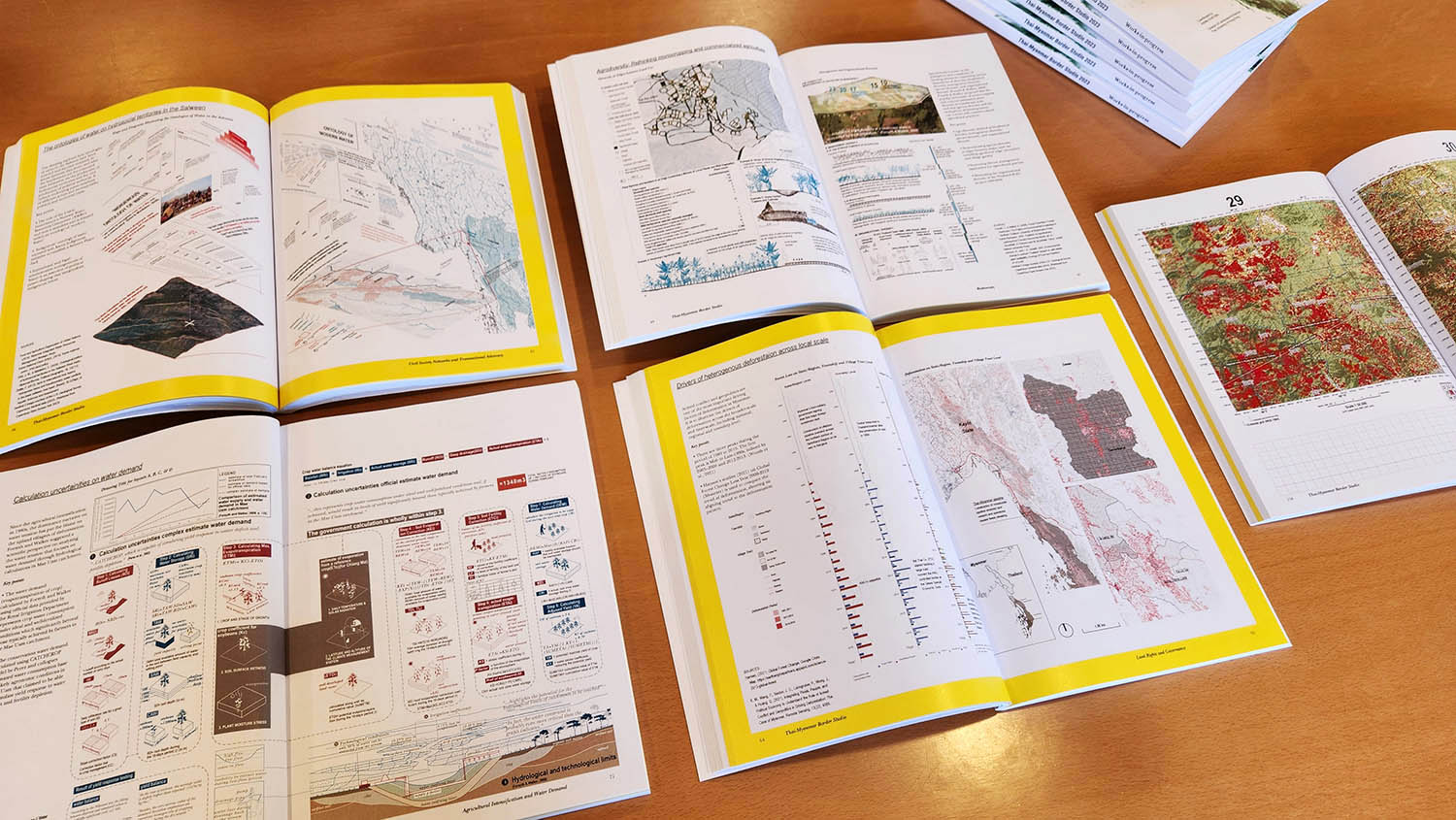
Studio mid-term report developed and presented by students to organizations on the ground in northern Thailand, 2023.
Karen/Kayin State, Myanmar viewed from Tak province, Thailand. By Ashley Scott Kelly, 2023.
Mae La, Thailand’s largest refugee camp. By Ashley Scott Kelly, 2023.
Industrial enclaves along the Thai-Myanmar border. By Sandra Saw Yu Nwe, 2023.

Posted by: (Design for Conservation)